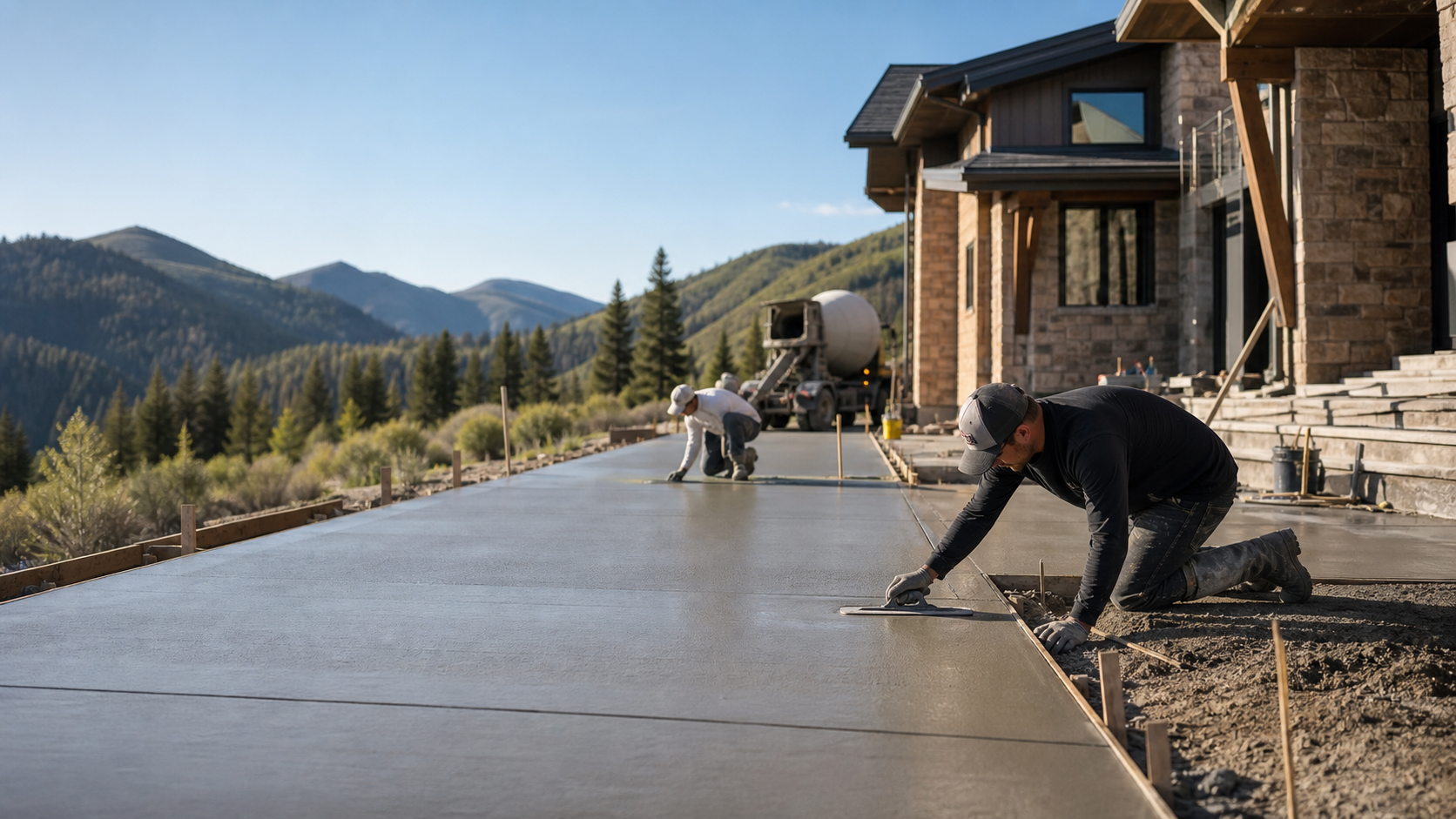
What affects the job
Concrete scope changes with demolition, forms, excavation, base prep, reinforcement, slab thickness, finish, drainage, access, pumping, weather, and whether the concrete is decorative, structural, or purely functional.
Details to gather before requesting pricing
Useful details include photos, rough measurements, site access, slope, drainage problems, existing concrete condition, finish preference, desired timeline, and whether engineering or permits may be involved.
Park City planning notes
Mountain properties can add steep driveways, tight equipment access, retaining needs, winter curing concerns, high-end finish expectations, and schedule pressure around remodels, rentals, and second-home visits.
Choosing a finish for snow, sun, and steep terrain
Broom, exposed aggregate, stamped, and integrally colored finishes all perform differently under Park City conditions. A broom finish is usually the most forgiving choice for winter traction and the easiest to reseal, while stamped or heavily textured patterns can trap moisture in the tooled joints if they are not sealed and maintained on schedule. Exposed aggregate can look striking against a mountain backdrop but may need more careful control-joint placement to avoid uneven wear. Whichever finish is chosen, ask how it performs specifically under repeated snow load, shoveling, and deicer exposure rather than how it looks in a warm-climate sample photo.
Freeze-thaw finishes and drainage on mountain patios
Most Park City properties sit above 6,900 feet, where exterior concrete goes through more annual freeze-thaw cycles than a comparable valley property. Patios are especially exposed because they hold snow load, shed roof runoff, and often sit close to landscaping that traps moisture against the slab edge. An air-entrained mix helps a patio resist the cracking and surface scaling that freeze-thaw cycling causes over time, and correct slope away from the house, plus control joints placed to manage cracking, matter as much as the finish itself. A patio that pitches toward a foundation, deck footing, or walkway instead of away from it is a common source of later drainage complaints.
Heated patios and hot tub pads
Some Park City homeowners extend a snowmelt system from the driveway into an adjoining patio, entry, or hot tub pad so ice does not build up on frequently used outdoor space. Because the tubing or cable is embedded before the pour, this decision needs to be made while the patio is still being designed, not after. The heated driveway and snowmelt guide covers how these systems are zoned and installed, and the same planning applies to a heated patio section.
HOA design review for outdoor living space
Communities such as Promontory, Deer Valley, and Canyons Village often review patio finish, color, and sometimes lighting or fire-feature placement as part of an architectural approval process. Checking those guidelines before finalizing a patio design, especially for stamped or decorative finishes, helps avoid a redesign after a bid is already in hand. See stamped concrete for finish-specific planning notes.
Loads, sealers, and short-season scheduling
Hot tubs, outdoor kitchens, and fire features add real point loads and utility rough-in that should be planned into the patio slab rather than added after the pour. A hot tub pad typically needs its own thickness and reinforcement check based on filled weight, and gas or electrical rough-in for a kitchen or fire feature is far easier to place before concrete goes down. High-elevation sun exposure is also harder on sealers than lower altitudes; ask what sealer is specified and how often it needs reapplication to keep a decorative or stamped finish looking right through repeated freeze-thaw winters. Because the exterior pour season at this elevation generally runs late spring through early fall, patio projects tied to a remodel completion date, rental turnover, or a specific summer event should be scheduled well ahead of that window.
Matching a patio to how the property is used
A patio on a full-time residence gets used differently than one on a second home that sits empty for weeks at a time. Full-time properties often justify a heated section near doors and steps so ice does not build up on a daily walking path, while a lightly used second home may prioritize a durable, low-maintenance finish over a heated zone. Rental properties add another layer: guests may not know to avoid an icy patio edge, so grading, traction, and lighting near steps and transitions are worth extra attention. Whatever the use case, photos of the existing grade, nearby landscaping, roofline, and any structures the patio ties into give a contractor a much faster and more accurate starting point than dimensions alone.