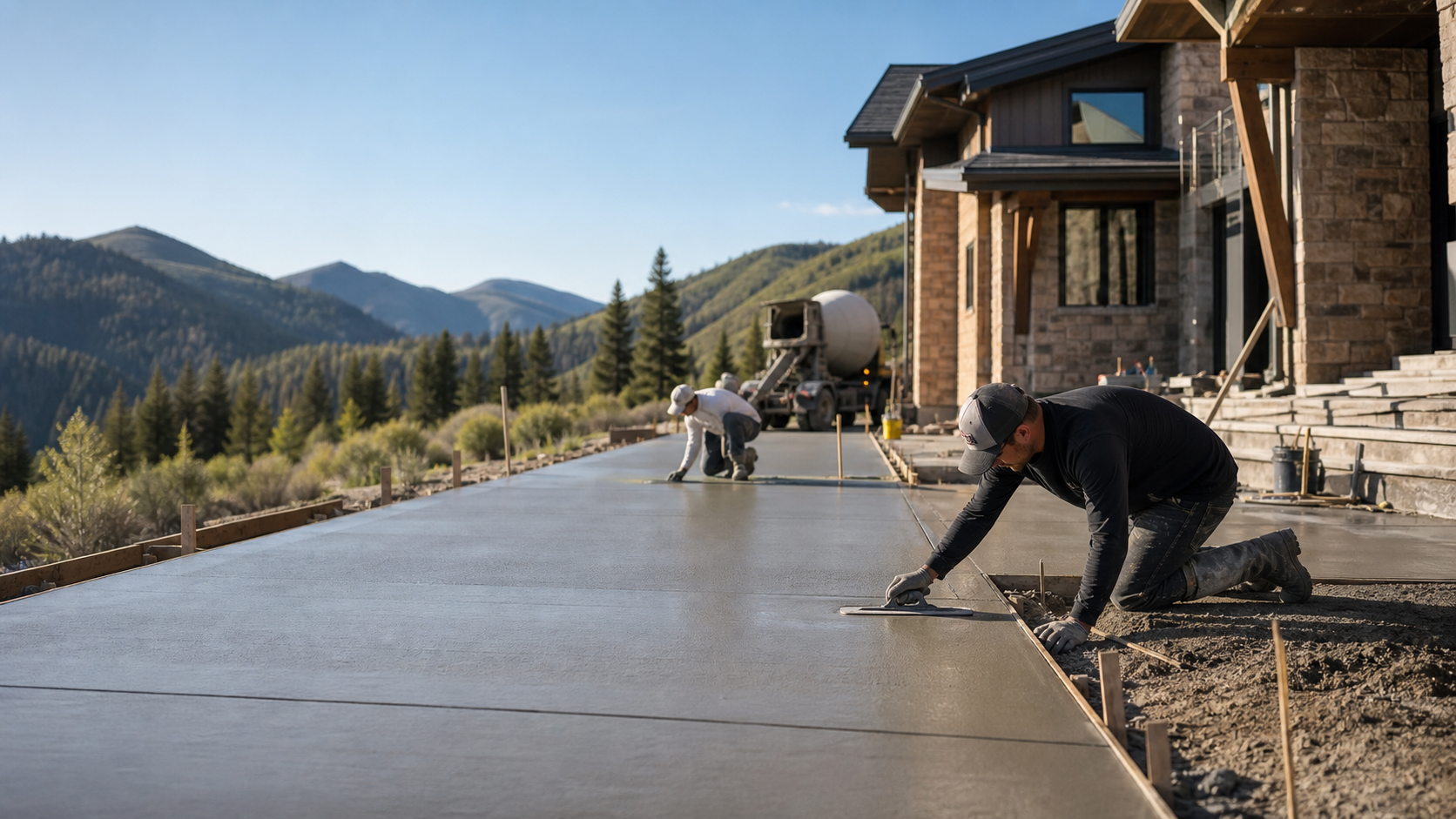
What affects the job
Concrete scope changes with demolition, forms, excavation, base prep, reinforcement, slab thickness, finish, drainage, access, pumping, weather, and whether the concrete is decorative, structural, or purely functional.
Details to gather before requesting pricing
Useful details include photos, rough measurements, site access, slope, drainage problems, existing concrete condition, finish preference, desired timeline, and whether engineering or permits may be involved.
Park City planning notes
Mountain properties can add steep driveways, tight equipment access, retaining needs, winter curing concerns, high-end finish expectations, and schedule pressure around remodels, rentals, and second-home visits.
Finish choices for everyday mountain wear
A broom finish remains one of the most practical choices for flatwork that sees regular foot traffic, snow shoveling, and deicer, because it holds up well and is straightforward to reseal. Exposed aggregate and lightly stamped finishes can work on lower-traffic pads or decorative walkways but need more attention to sealing and joint maintenance to avoid trapping moisture that can accelerate freeze-thaw damage. For utility flatwork such as equipment pads or side-yard walks, function usually outweighs decorative finish, and a simple, well-sloped broom finish is often the more durable long-term choice.
Elevation, freeze-thaw, and mix design for flatwork
Most Park City neighborhoods sit above 6,900 feet, where exterior flatwork goes through more annual freeze-thaw cycles than a comparable valley property. Patios, walks, pads, and aprons are all exposed to snow load, shoveling, and deicer exposure, so an air-entrained mix is typically specified to help the concrete resist the cracking and surface scaling that repeated freezing and thawing causes over time. A finish that looks fine the first summer can start scaling or spalling within a couple of winters if the mix was not built for the climate, so it is worth asking directly whether a bid accounts for freeze-thaw exposure.
Drainage and grade on sloped mountain lots
Flatwork on a sloped lot has to manage water differently than a flat valley site. Grade, drainage swales, and control-joint placement all affect whether a pad, walk, or apron sheds water away from the house, a retaining wall, or a neighboring structure instead of pooling or icing over. Roof runoff, snow-storage areas, and spring melt from surrounding slopes should all be considered when planning flatwork, since a pad that looks correctly sloped in dry conditions can still direct water the wrong way once snow is piled against it in winter.
Heated flatwork sections
Some flatwork, particularly entries, walkways between a garage and front door, and hot tub or equipment pads, can include a snowmelt zone extended from a driveway system or run independently. Because the tubing or cable is embedded before the pour, that decision needs to be made while the flatwork is still being scoped. See the heated driveway and snowmelt guide for how these systems are planned and zoned.
Scheduling flatwork around the pour season
Exterior flatwork generally gets scheduled from late spring through early fall at this elevation, since many batch plants and crews slow down once nighttime temperatures are consistently below freezing. Flatwork tied to a remodel, new build, or rental-turnover deadline should be scheduled with that shortened window in mind, and coordinating flatwork with a related patio, driveway, or garage slab pour on the same visit can also reduce mobilization costs.
Coordinating flatwork with a larger project
Flatwork rarely happens in isolation on a Park City property. A garage slab, walkway, and small equipment pad might all get poured on the same visit as a driveway or patio job, and doing so can reduce mobilization and pump-truck costs compared to scheduling each piece separately. On a remodel or custom-home build, coordinating flatwork timing with landscaping, decking, and hardscape contractors also helps avoid a patio or walk being poured before final grade is set, which can force costly rework later.